
A smarter fence starts here
06 Oct 2026 · 10 min read
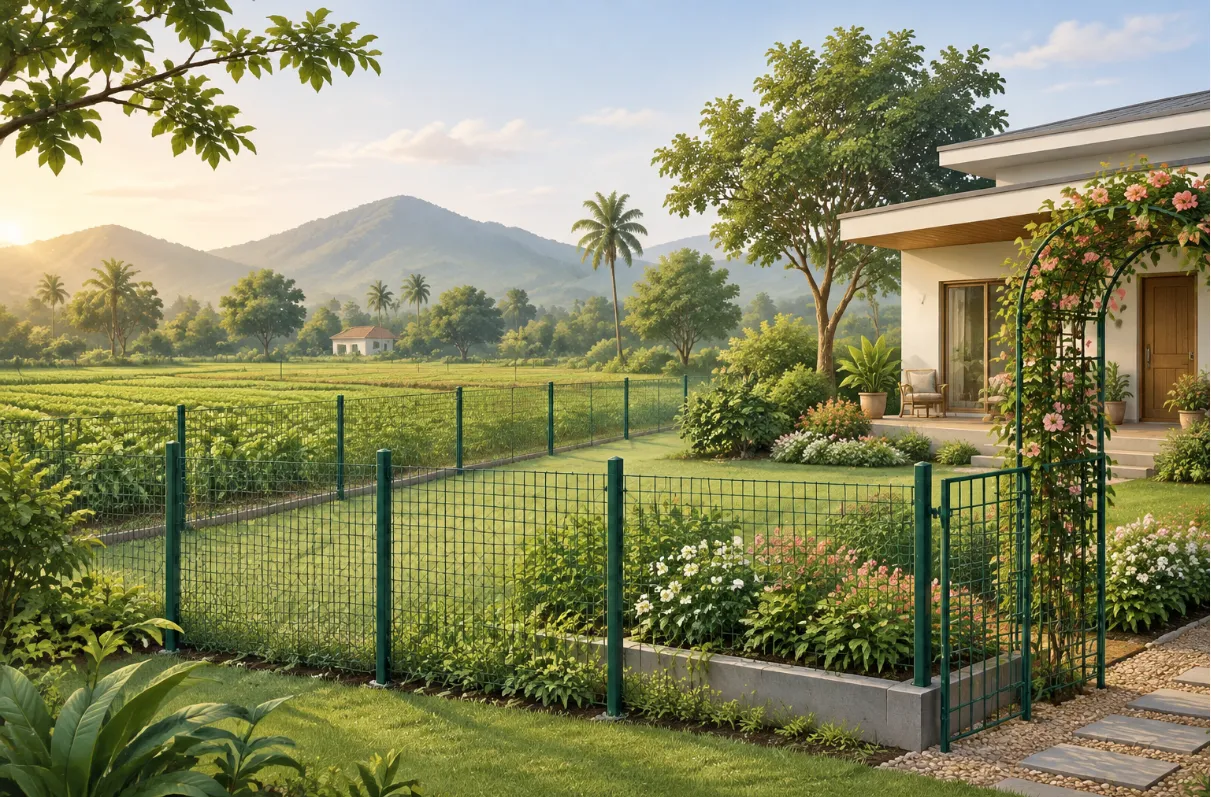
# How to Choose the Right Fencing in India: A Practical Guide for Farms, Homes and Gardens
A fence is a decision about how you want your space to work. On a farm, it may help define a boundary and manage movement. Around a home, it may separate a garden from the road. On a terrace, the priority might be privacy rather than perimeter protection.
That is why the best fencing for one property can be the wrong choice for another. Before comparing rolls, panels or poles, ask a simpler question: what should this boundary actually do?
This guide walks through fencing options in India, the details that affect a project budget and the questions worth asking before you buy.
## 1. Give your fence a job before you give it a budget
Start with one main purpose. Do you need to mark a boundary, manage animals, protect a planted area, create privacy or improve an outdoor space? Then list the secondary needs: appearance, visibility, access, maintenance and future expansion.
These goals can pull in different directions. An open mesh can preserve views, but it will not screen a terrace from neighbours. A decorative trellis can organise a garden beautifully, but it should not automatically be treated as a high-security barrier. A wire boundary may suit a large site while being unsuitable beside a frequently used children's play area.
Write a short project brief: "I need a boundary around a farm, with access for a tractor and a separate enclosure for poultry." That is more useful than "I need the cheapest fence."
For animal containment or exclusion, name the animals involved. A solution for poultry is not automatically suitable for goats, dogs or wildlife. Ask the supplier or installer to assess the specific use, mesh opening, height, ground-level gaps and gate arrangement. No general-purpose fence should be assumed to solve every animal problem.
## 2. Understand the difference between fencing, screening and trellis
These products may appear together in a catalogue, but their jobs differ.
### Mesh fencing: an open boundary
Mesh creates a continuous barrier while allowing visibility through it. Chain link uses interwoven wire in a diamond pattern. Other mesh products use different patterns and materials, so two rolls that look similar in a photograph may have different specifications.
Compare the material, opening size, wire thickness, height and roll length. Ask how the mesh should be supported, fastened and finished at the bottom. The complete system matters more than the roll alone.
JF Products lists JF Polyhex Mesh as PET wire woven into a hexagonal pattern, with applications including gardens and agricultural boundaries. Explore the product specifications, then confirm that the selected variant and installation plan suit your site. A listed application is a starting point for a conversation, not a guarantee of suitability for every project.
### Barbed wire: a sharp boundary deterrent
Barbed wire uses strands with sharp barbs and is commonly associated with agricultural boundaries. It deserves careful placement because those barbs can injure people and animals. Do not select it simply because the material appears inexpensive.
Consider who walks beside the fence, whether children or pets can reach it and whether a different barrier would better fit the setting. Strand arrangement, supports and animal requirements need a site-specific plan. Check applicable local requirements before installation.
### Trellis: structure for a designed space
Trellis is useful when the boundary is part of the garden's appearance. It can create a visual division or a framework for a planting design. However, do not assume every decorative panel is rated for the weight of mature climbing plants. Confirm how it should be mounted and what load its supports can carry.
JF Indian Trellis is listed as a jointed polypropylene panel measuring 1216 mm by 2400 mm, with 5 mm thickness and 27–28 mm openings. Those details help you plan panel coverage and compare options. Installation still depends on the supporting frame or surface and the layout of your space.
### Privacy screening: a different question from security
If your main concern is an exposed balcony or an open fence overlooking a busy area, screening may be more relevant than a new perimeter fence.
JF Privezy Grass Wall is an artificial-grass product with chain-link mesh backing, listed for spaces including balconies, terraces and boundary walls. It can add a green visual screen without growing live plants. It is not a living wall, and a privacy covering should not be assumed to make an existing fence more secure.
Before adding any screen, ask an installer to check the supporting structure, fixing method and exposure to wind. Do not cover or modify a balcony safety barrier without checking that the proposed installation is appropriate.
## 3. Match the option to the property, not the product photograph
### For farms and agricultural land
Separate the outer boundary from any inner enclosure. A farm may need vehicle access, pedestrian gates and a smaller protected area for plants or animals. One material does not have to do every job.
Walk the proposed fence line and note slopes, low points, drainage routes, existing trees and changes in ground level. Show the installer where animals have previously entered, if that is the problem you are trying to solve. A photograph of a straight, level installation does not show how it will behave on your land.
### For homes and gardens
Think about everyday contact. Where will people walk? Can children or pets reach the boundary? Do you want the fence to disappear visually, frame a garden or become a decorative feature?
Trellis, mesh and privacy products can serve different parts of the same property. A garden partition does not need to be treated as an entrance gate, and a decorative screen does not replace a properly designed safety barrier.
### For commercial properties
Start with access and operation. Where do people enter? Which areas need visibility? Is the proposed boundary mainly for separation, visitor guidance or perimeter protection?
Check the requirements of the specific premises rather than borrowing a residential layout. Keep gates, emergency access and maintenance access in the discussion from the beginning. High-security requirements need a specialist design, not a product selected by appearance alone.
## 4. Why "fencing cost per acre" is only the starting question
Acreage tells you the area of land. Fencing follows its boundary. Two plots with the same area can have different boundary lengths, so a per-acre figure alone is not enough for a reliable quote.
Ask for a cost based on the measured perimeter and the actual installation specification. Break the quote into:
- Fence material: type, selected variant, height and required quantity.
- Supports: poles or posts, corner arrangements and foundations.
- Accessories: fasteners, clamps and any specified tensioning components.
- Gates: number, size, hardware and supporting structure.
- Site work: clearing, ground preparation and installation labour.
- Delivery and taxes: what is included and what is additional.
A price for a roll is not the price of a finished boundary. A panel price is not necessarily the cost of a mounted screen. Compare like-for-like quotes before deciding which option offers better value.
Also ask what happens after installation. Which parts require inspection? Can a damaged section be replaced separately? What does the written warranty cover, and what does it exclude? Avoid treating a general promise of durability as a substitute for specific terms.
## 5. Check the details that a product photograph cannot show
### Material and finish
Metal, PET and polypropylene are different material choices. Ask why the selected material fits the use, exposure and installation. For metal fencing, check the specified coating or finish rather than relying on a general phrase such as "rust-resistant".
### Openings and thickness
Compare actual dimensions, not only product names. Openings matter when containment or exclusion is part of the job. Thickness also needs to be understood alongside material and construction; it is not a universal strength score across different products.
### Supports, corners and gates
A boundary is a connected system. Ask for a layout showing how the fence is supported, where corners occur and how gates connect to it. Do not choose post spacing from a generic online diagram without checking the proposed system and site.
### Ground and weather exposure
Tell the supplier about sloping ground, wet areas and exposed locations. For panels and screens, discuss fixing and support before ordering. Do not assume that "weather resistant" means a product can be installed in any way or left unchecked indefinitely.
## 6. Five buying mistakes worth avoiding
**Buying before measuring.** Record boundary lengths or screen dimensions first. Mark gates and interruptions instead of ordering against a rough acreage estimate.
**Choosing on price alone.** Compare the installed system, including supports and accessories, rather than the headline material price.
**Using privacy as a synonym for security.** A covering may reduce visibility without changing the underlying barrier's strength or access control.
**Ignoring the gate.** Plan for the largest item that needs to pass through, such as equipment, a vehicle or garden maintenance tools. Confirm the final dimensions with the installer.
**Assuming a use case is a guarantee.** A product described for agriculture, pets or gardens still needs the right variant and installation. Ask about your actual conditions.
## 7. Your before-you-buy fencing checklist
Prepare these details before requesting guidance:
1. Property location and delivery PIN code.
2. Main purpose of the fence or screen.
3. Measured boundary length, or panel coverage dimensions.
4. Desired height and any specific containment requirements.
5. Photos of the site, including corners, slopes and existing supports.
6. Gate locations and access needs.
7. Exposure to wind, water and regular human or animal contact.
8. Budget for the complete installation, not only the material.
9. Whether you need supply only or a separate installation plan.
This brief makes it easier to compare options and reduces the chance of ordering a product that does not fit the job.
## Frequently asked questions
### What is the best fencing for agricultural land in India?
There is no single best option for every farm. The purpose, animals involved, boundary length, ground conditions and installation budget determine the choice. Start with a site assessment and compare complete systems, not isolated rolls.
### How do I estimate fencing cost for one acre?
Measure the boundary and specify the material, height, supports, gates and installation work. Acreage alone does not describe the perimeter or the site conditions. Request an itemised quote for the actual layout.
### Can a trellis replace a security fence?
Do not assume so. A decorative trellis and a security barrier have different requirements. Check the product's stated purpose and ask for a design appropriate to the protection you need.
### Is an artificial grass wall the same as a living green wall?
No. An artificial grass wall uses synthetic material rather than live plants. It can provide a green visual finish without plant care, but it should be selected and described as artificial screening.
### What should I send a fencing supplier before ordering?
Send your location, measurements, purpose, site photographs and gate requirements. Include any animal-containment needs and ask for written specifications and installation requirements.
## A better boundary starts with a better brief
The right fence should fit the way you use your land, home or garden. Begin with purpose, measure the space and compare the complete system. Then choose the product that answers those needs.
Explore the JF Products range, including Polyhex Mesh, decorative trellis and privacy solutions. For help narrowing the options, contact JF Products with your measurements and project details before you order.
A fence is a decision about how you want your space to work. On a farm, it may help define a boundary and manage movement. Around a home, it may separate a garden from the road. On a terrace, the priority might be privacy rather than perimeter protection.
That is why the best fencing for one property can be the wrong choice for another. Before comparing rolls, panels or poles, ask a simpler question: what should this boundary actually do?
This guide walks through fencing options in India, the details that affect a project budget and the questions worth asking before you buy.
## 1. Give your fence a job before you give it a budget
Start with one main purpose. Do you need to mark a boundary, manage animals, protect a planted area, create privacy or improve an outdoor space? Then list the secondary needs: appearance, visibility, access, maintenance and future expansion.
These goals can pull in different directions. An open mesh can preserve views, but it will not screen a terrace from neighbours. A decorative trellis can organise a garden beautifully, but it should not automatically be treated as a high-security barrier. A wire boundary may suit a large site while being unsuitable beside a frequently used children's play area.
Write a short project brief: "I need a boundary around a farm, with access for a tractor and a separate enclosure for poultry." That is more useful than "I need the cheapest fence."
For animal containment or exclusion, name the animals involved. A solution for poultry is not automatically suitable for goats, dogs or wildlife. Ask the supplier or installer to assess the specific use, mesh opening, height, ground-level gaps and gate arrangement. No general-purpose fence should be assumed to solve every animal problem.
## 2. Understand the difference between fencing, screening and trellis
These products may appear together in a catalogue, but their jobs differ.
### Mesh fencing: an open boundary
Mesh creates a continuous barrier while allowing visibility through it. Chain link uses interwoven wire in a diamond pattern. Other mesh products use different patterns and materials, so two rolls that look similar in a photograph may have different specifications.
Compare the material, opening size, wire thickness, height and roll length. Ask how the mesh should be supported, fastened and finished at the bottom. The complete system matters more than the roll alone.
JF Products lists JF Polyhex Mesh as PET wire woven into a hexagonal pattern, with applications including gardens and agricultural boundaries. Explore the product specifications, then confirm that the selected variant and installation plan suit your site. A listed application is a starting point for a conversation, not a guarantee of suitability for every project.
### Barbed wire: a sharp boundary deterrent
Barbed wire uses strands with sharp barbs and is commonly associated with agricultural boundaries. It deserves careful placement because those barbs can injure people and animals. Do not select it simply because the material appears inexpensive.
Consider who walks beside the fence, whether children or pets can reach it and whether a different barrier would better fit the setting. Strand arrangement, supports and animal requirements need a site-specific plan. Check applicable local requirements before installation.
### Trellis: structure for a designed space
Trellis is useful when the boundary is part of the garden's appearance. It can create a visual division or a framework for a planting design. However, do not assume every decorative panel is rated for the weight of mature climbing plants. Confirm how it should be mounted and what load its supports can carry.
JF Indian Trellis is listed as a jointed polypropylene panel measuring 1216 mm by 2400 mm, with 5 mm thickness and 27–28 mm openings. Those details help you plan panel coverage and compare options. Installation still depends on the supporting frame or surface and the layout of your space.
### Privacy screening: a different question from security
If your main concern is an exposed balcony or an open fence overlooking a busy area, screening may be more relevant than a new perimeter fence.
JF Privezy Grass Wall is an artificial-grass product with chain-link mesh backing, listed for spaces including balconies, terraces and boundary walls. It can add a green visual screen without growing live plants. It is not a living wall, and a privacy covering should not be assumed to make an existing fence more secure.
Before adding any screen, ask an installer to check the supporting structure, fixing method and exposure to wind. Do not cover or modify a balcony safety barrier without checking that the proposed installation is appropriate.
## 3. Match the option to the property, not the product photograph
### For farms and agricultural land
Separate the outer boundary from any inner enclosure. A farm may need vehicle access, pedestrian gates and a smaller protected area for plants or animals. One material does not have to do every job.
Walk the proposed fence line and note slopes, low points, drainage routes, existing trees and changes in ground level. Show the installer where animals have previously entered, if that is the problem you are trying to solve. A photograph of a straight, level installation does not show how it will behave on your land.
### For homes and gardens
Think about everyday contact. Where will people walk? Can children or pets reach the boundary? Do you want the fence to disappear visually, frame a garden or become a decorative feature?
Trellis, mesh and privacy products can serve different parts of the same property. A garden partition does not need to be treated as an entrance gate, and a decorative screen does not replace a properly designed safety barrier.
### For commercial properties
Start with access and operation. Where do people enter? Which areas need visibility? Is the proposed boundary mainly for separation, visitor guidance or perimeter protection?
Check the requirements of the specific premises rather than borrowing a residential layout. Keep gates, emergency access and maintenance access in the discussion from the beginning. High-security requirements need a specialist design, not a product selected by appearance alone.
## 4. Why "fencing cost per acre" is only the starting question
Acreage tells you the area of land. Fencing follows its boundary. Two plots with the same area can have different boundary lengths, so a per-acre figure alone is not enough for a reliable quote.
Ask for a cost based on the measured perimeter and the actual installation specification. Break the quote into:
- Fence material: type, selected variant, height and required quantity.
- Supports: poles or posts, corner arrangements and foundations.
- Accessories: fasteners, clamps and any specified tensioning components.
- Gates: number, size, hardware and supporting structure.
- Site work: clearing, ground preparation and installation labour.
- Delivery and taxes: what is included and what is additional.
A price for a roll is not the price of a finished boundary. A panel price is not necessarily the cost of a mounted screen. Compare like-for-like quotes before deciding which option offers better value.
Also ask what happens after installation. Which parts require inspection? Can a damaged section be replaced separately? What does the written warranty cover, and what does it exclude? Avoid treating a general promise of durability as a substitute for specific terms.
## 5. Check the details that a product photograph cannot show
### Material and finish
Metal, PET and polypropylene are different material choices. Ask why the selected material fits the use, exposure and installation. For metal fencing, check the specified coating or finish rather than relying on a general phrase such as "rust-resistant".
### Openings and thickness
Compare actual dimensions, not only product names. Openings matter when containment or exclusion is part of the job. Thickness also needs to be understood alongside material and construction; it is not a universal strength score across different products.
### Supports, corners and gates
A boundary is a connected system. Ask for a layout showing how the fence is supported, where corners occur and how gates connect to it. Do not choose post spacing from a generic online diagram without checking the proposed system and site.
### Ground and weather exposure
Tell the supplier about sloping ground, wet areas and exposed locations. For panels and screens, discuss fixing and support before ordering. Do not assume that "weather resistant" means a product can be installed in any way or left unchecked indefinitely.
## 6. Five buying mistakes worth avoiding
**Buying before measuring.** Record boundary lengths or screen dimensions first. Mark gates and interruptions instead of ordering against a rough acreage estimate.
**Choosing on price alone.** Compare the installed system, including supports and accessories, rather than the headline material price.
**Using privacy as a synonym for security.** A covering may reduce visibility without changing the underlying barrier's strength or access control.
**Ignoring the gate.** Plan for the largest item that needs to pass through, such as equipment, a vehicle or garden maintenance tools. Confirm the final dimensions with the installer.
**Assuming a use case is a guarantee.** A product described for agriculture, pets or gardens still needs the right variant and installation. Ask about your actual conditions.
## 7. Your before-you-buy fencing checklist
Prepare these details before requesting guidance:
1. Property location and delivery PIN code.
2. Main purpose of the fence or screen.
3. Measured boundary length, or panel coverage dimensions.
4. Desired height and any specific containment requirements.
5. Photos of the site, including corners, slopes and existing supports.
6. Gate locations and access needs.
7. Exposure to wind, water and regular human or animal contact.
8. Budget for the complete installation, not only the material.
9. Whether you need supply only or a separate installation plan.
This brief makes it easier to compare options and reduces the chance of ordering a product that does not fit the job.
## Frequently asked questions
### What is the best fencing for agricultural land in India?
There is no single best option for every farm. The purpose, animals involved, boundary length, ground conditions and installation budget determine the choice. Start with a site assessment and compare complete systems, not isolated rolls.
### How do I estimate fencing cost for one acre?
Measure the boundary and specify the material, height, supports, gates and installation work. Acreage alone does not describe the perimeter or the site conditions. Request an itemised quote for the actual layout.
### Can a trellis replace a security fence?
Do not assume so. A decorative trellis and a security barrier have different requirements. Check the product's stated purpose and ask for a design appropriate to the protection you need.
### Is an artificial grass wall the same as a living green wall?
No. An artificial grass wall uses synthetic material rather than live plants. It can provide a green visual finish without plant care, but it should be selected and described as artificial screening.
### What should I send a fencing supplier before ordering?
Send your location, measurements, purpose, site photographs and gate requirements. Include any animal-containment needs and ask for written specifications and installation requirements.
## A better boundary starts with a better brief
The right fence should fit the way you use your land, home or garden. Begin with purpose, measure the space and compare the complete system. Then choose the product that answers those needs.
Explore the JF Products range, including Polyhex Mesh, decorative trellis and privacy solutions. For help narrowing the options, contact JF Products with your measurements and project details before you order.